
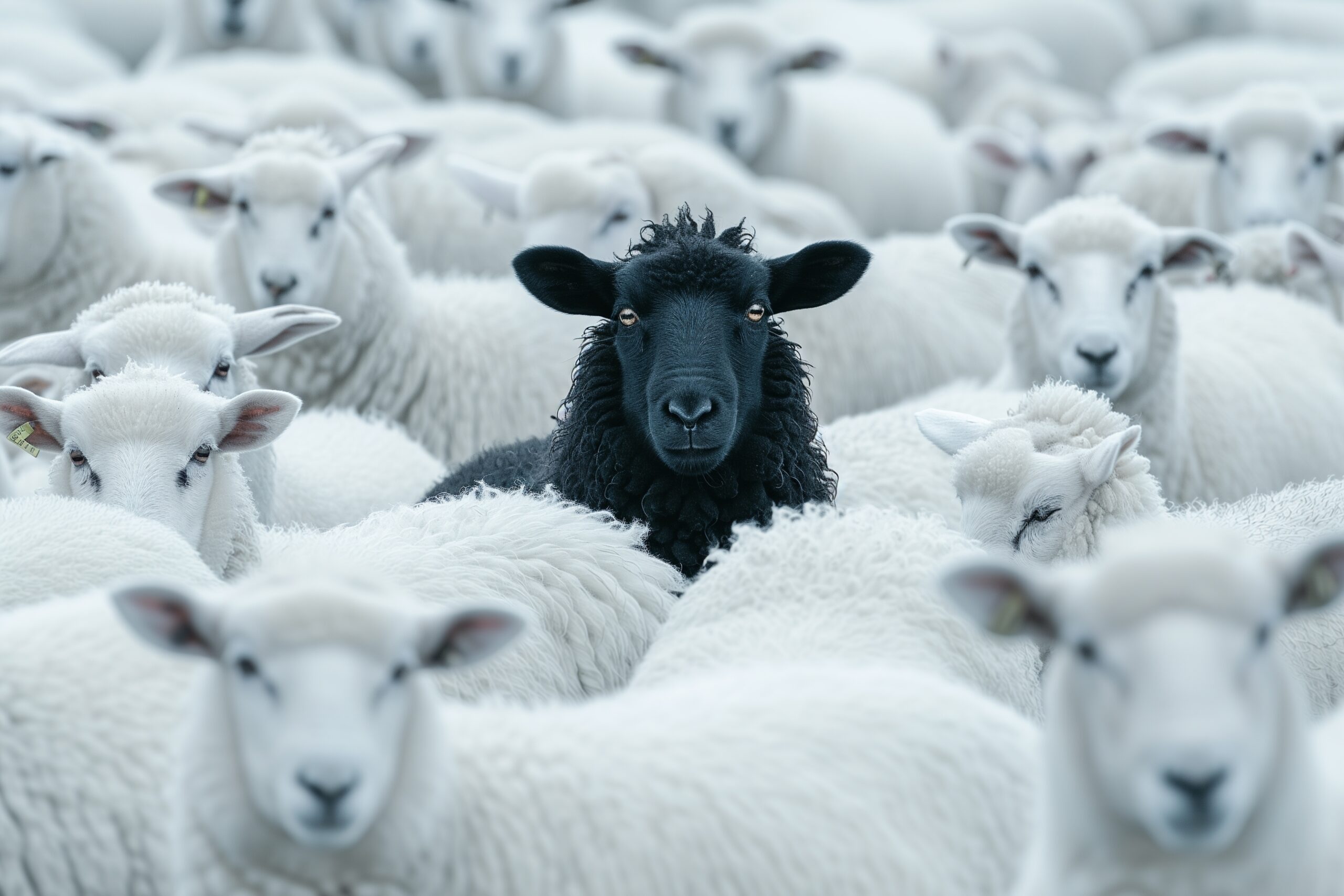
If ever there were a true adage about “you can’t live with ‘em, you can’t live without ‘em,” it’s the story — sometimes epically so — of the roller coaster ride families endure when blessed with (or burdened by) a Black Sheep.
To bring you up to speed, a Black Sheep is the one family member who 1) doesn’t really seem to fit in the family unit, 2) has their own unique way of expressing themselves, 3) isn’t interested in being like everybody else, 4) is the one person who’s going to challenge all of the family’s behavioral patterns and established norms, and 5) isn’t going to put up with rules they have determined are useless, meaningless, and/or irrational.
The term “black sheep” comes from a flock of sheep, whose coloring is white. Obviously, a black sheep is going to stand out in a sea of white. Back in the 18th and 19th centuries, black wool was worth less simply because it couldn’t be dyed another color. The color black was also considered to be the mark of the Devil.
In today’s vernacular, Black Sheep are often characterized as the “bad seed” or “bad boy/bad girl” simply because they tend to oppose the norms within a family.
- They are often the ones wanting to try new things, push beyond the usual boundaries, break molds, and expand their horizons (think Prince).
- They can also be the ones who are withdrawn, brooding, contrary, and uninterested in conventional societal pursuits (think Wednesday Addams).
Both types need to be themselves, not facsimiles of what society considers normal, trendy, comfortable, or acceptable. They’re definitely not followers, and they aren’t interested in being leaders. They inherently are, in a word, iconoclasts. That word comes from the Greek “eikonoklastēs, which translates to “image destroyer.” Whoa — that’s pretty intense, and within a family unit, it can feel as though their Black Sheep is putting everyone through the meat grinder.

Family cohesion and stability are going to be challenged because their Black Sheep is going to push a lot of buttons: patience, tolerance, boundaries, values and beliefs, authority, and roles and rules.
Black Sheep generally know from an early age that how their family operates and where they fit in the family dynamic doesn’t work for them. They observe how their family behaves and interacts, what their beliefs and values are, and what they consider important. With all of that taken into account, many Black Sheep realize that they’re 180 degrees opposite their family. The upshot is that they can’t relate to their family members and, vice versa, no one in their family can relate to them. Therefore, they stand alone.
A person who fits the profile of a Black Sheep often feels that they’re not understood and that no one in their family is even trying to understand them. That leads to a sense of not being seen, not heard, and not valued in the family. The result is that the Black Sheep will either go to an extreme to somehow gain attention from their family or decide to create distance and withdraw from them.
Either way, family members end up being shut out because they can’t keep up with their Black Sheep, don’t approve of their Black Sheep’s decisions and actions, or feel they are unable to connect with and emotionally and mentally relate to or bond with their Black Sheep.
Families find living with a Black Sheep challenging because 1) they’re seeking familial closeness and unity, and 2) Black Sheep often add to the day’s struggles, stress, and chaos. The family wants the Black Sheep to join in on family activities, but they’ll either get a “leave me alone” response or the opposite, wherein the Black Sheep will respond with an over-the-top reaction that will run the entire family ragged.
Black sheep can sometimes be what’s termed the “class clown.” For them, they see a need to liven things up, and humor is their instinctual, as well as standard choice. They’ll go to outlandish lengths to brighten the mood, which can mean doing things that aren’t exactly appropriate for the situation, could be foolhardy and end in disaster, or people’s feelings could be inadvertently hurt.
Because of this unconventional behavior, the Black Sheep set themselves up for further distancing from family members and being characterized as unreliable, untrustworthy, irrational, and reckless. The family is clueless as to why the Black Sheep behaves the way they do, believing that they’ve been told enough times to not do something and why, or to stop whatever they’re doing. Basically, all that admonishment falls on deaf ears.
What can occur on both sides after a while is resentment simply because neither side feels acknowledged in a positive way or feels heard. What builds then is distrus,t and everyone begins the process of shutting out the other.
For the Black Sheep, constant criticism is interpreted as “I’m bad,” “I’m wrong,” “There’s something wrong with me.” That eventually devolves into “No one gets me,” “No one likes me,” “I’m a disgrace to my family,” “I don’t belong,” and “I’m not wanted.” This can turn into the Black Sheep feeling that they’re a threat to their family. Conversely, the Black Sheep may feel that their family is a threat to them and their sense of identity not only within the family but the world at large.
Unfortunately, many families who have a Black Sheep in their midst will turn to scapegoating them because they are unable to understand, work with, or tolerate their Black Sheep’s behavior. They consider that what their Black Sheep does is incomprehensible, too divergent, and they just don’t fit within the family’s reality band. Hence, their Black Sheep becomes a target in they are to blame for all the family’s internal issues.
Families then arrive at an impasse, often giving up on their Black Sheep, leaving the Black Sheep feeling abandoned and rejected. The Black Sheep eventually arrives at the decision that their only option for survival is to leave the family unit. Both sides lose in this case.
But there’s another way to look at the Black Sheep Phenomenon: As challenging as a Black Sheep may be in a family, they actually play a very important role.
For many families, a point is reached within the family dynamic wherein complacency, habitual behavior, and dysfunctional relationship patterns put the family in a psychological and operative rut. The one person who’s going to break the family out of their stasis is the Black Sheep — and that’s the power a Black Sheep has within a family.

The Black Sheep member is the one who is really going to show what it means to be themselves, to not be a carbon copy of others. Black Sheep can develop a very strong sense of their unique identity that they’ll stand by despite the odds. They will own their voice and sense of self in the world, making them not so vulnerable to criticism. They will often have greater compassion and empathy for those who are perceived as “other” thereby making them more inclusive and accepting of others’ uniqueness.
Black Sheep also don’t feel obligated to follow familial and societal conventions, which gives them greater freedom to express themselves, to be who they are as fully as possible. In that sense, they become models for others to emulate, as it gives them permission to be themselves.
Though Black Sheep can get your knickers in a twist, they are often the only ones in a family telling the truth and pushing for authenticity. That takes tremendous courage. As has been said, “The Black Sheep is often the most interesting and dynamic member of the family.” And as Maxime Lagacé said, “I thought not fitting in was something I had to fix. Now I see it as my superpower.”
If you’re the Black Sheep in your family, celebrate your uniqueness, strive to be the most authentic you possible, and let your superpower shine!
