

Trauma comes in many forms and affects each of us differently. What causes trauma is physical and emotional pain, fear, loss, betrayal, abuse of power, helplessness, confusion, and extraordinarily destructive events.
Dealing with trauma can be complex simply because many people: 1) don’t know how to define what trauma actually is, 2) don’t know the many ways it can occur, 3) are unaware of how far-reaching trauma can be, 4) don’t realize how it can insinuate itself into their lives, and 5) are unable to cope with whatever trauma they’ve experienced.
Trauma is generally defined as any disturbing and/or intensely stressful experience that results in long-lasting negative effects on a person’s attitudes, behavior, ability to function, and overall well-being. In short, it’s any event that psychologically overwhelms a person emotionally and psychologically. That event can be something that happens unexpectedly and suddenly, like a crash or explosion, or could be an ongoing stressor, such as emotional abuse or childhood neglect.
Again, trauma affects each person differently, whether it’s experienced as a child or adult, as an individual or as a group. For some people, their trauma overtakes their lives, such as PTSD (Post-Traumatic Stress Disorder). Others turn their trauma into an ongoing relationship scenario from which they find it extremely difficult to extricate themselves. The term for both of these is “trauma bonding.”
Interestingly, some people are more susceptible to trauma bonding. Often, it’s people with low self-esteem, those who grew up in an atmosphere of fear and uncertainty, children who were abandoned or ignored, and those who witnessed a traumatic event that was never appropriately addressed.
Conversely, there are those who are specifically targeted by perpetrators. They include:
- People with dependent personalities
- A person who puts a lot of value on “the good times” and easily forgives
- Anyone with a history of being abused in childhood or past relationships
- People with disorganized, anxious, or avoidant attachment behavioral styles
- People with the tendency to question and blame themselves, despite strong evidence that suggests they aren’t to blame
- Existing mental health concerns, such as depression, bipolar disorder, and anxiety
- People who suffer from separation anxiety
- People who are sensitive to rejection
For the perpetrator, it’s all about power, control, and the belief in their superiority over others. For the person being abused, they most likely intellectually recognize the situation for what it is, yet just can’t bring themselves to believe that they’re being abused, and thus, traumatized. What’s set in motion is the debilitating trauma bonding dynamic.
There are two types of trauma bonding.
- The first type involves incorporating trauma into every aspect of a person’s life to the point that it dictates their feelings, perspectives, and beliefs.
Essentially, they let their trauma become the baseline upon which they make all their decisions about everything. It’s the lens through which they see all of life, thereby letting it define who they are, the type of relationships they’re involved in, the work they do, and their overall sense of reality.
- The second type of trauma bonding is a scenario many people are aware of but find hard to comprehend: the attachment an abused person develops for their abuser.
This dynamic is created when the abuser alternates between critical and fear-inducing behavior with moments of affection and remorse. The person being abused, despite the abuse showered upon them by their abuser, fully believes their abuser loves and cares for them. They also believe their abuser’s “sincere” protestations of regret and sorrow for their actions. For the person being abused, their belief — based in fear—is steadfast even though they intellectually know the abuse is going to happen again.
This sets into motion a relationship dynamic called “co-dependency,” wherein the abused individual modulates their behavior and actions so as to avoid upsetting or setting off an abusive episode by their abuser. The abused person lives their life constantly walking on eggshells, fearing another attack and possibly mortal harm. The underlying and overwhelming fear is that the abuser will reject and abandon them.
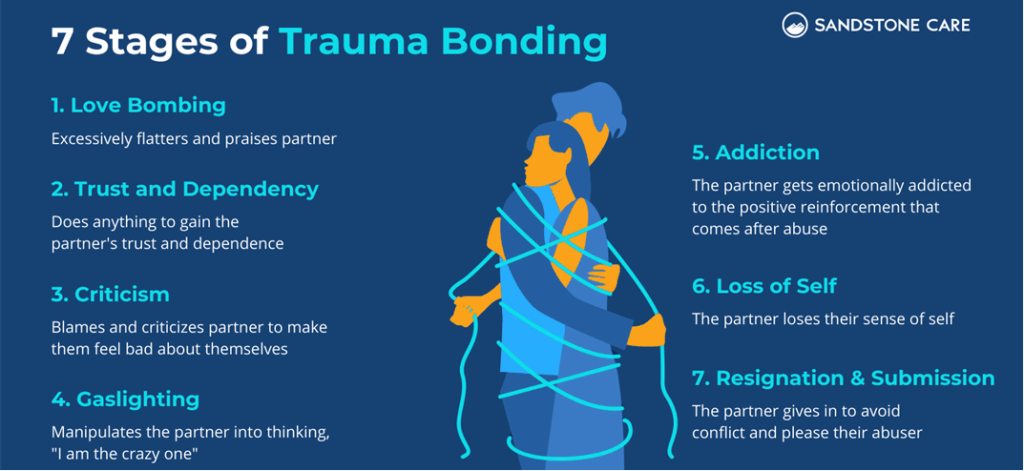
Within this second type of trauma bonding dynamic is a process that involves seven stages:
Love bombing — the abuser praises and excessively flatters their target, essentially, preying on their victim’s emotions and thereby creating a false sense of support, security, and stability.
Trust & Dependency — the abuser tests their target to the point that the abused person begins to doubt themselves and begins relying on the abuser for validation.
Criticism — the abuser begins the process of tearing down their target to weaken their sense of self-esteem, self-worth, and self-confidence. This is coupled with love bombing and testing the abused person’s trust in the abuser.
Manipulation & Gaslighting — the point of this is to get the abused person to doubt their sense of reality, primarily to get the abused person to believe that their perception of life is wrong and that their abuser is always right. When things go wrong, the abused person will blame themselves, never their abuser, and believe that they deserve whatever their abuser lays on them.
Resignation & Giving Up — the abused person reaches a point where they no longer believe they have the capacity to stand up for themselves. In order to “survive,” their reaction is to please and fawn over their abuser, as well as others around them, in order to avoid conflict.
Loss of Self — over time, the abused person loses their sense of identity and becomes dependent on their abuser for verification. In essence, the abused person becomes a slave to the abuser and is completely and emotionally dependent on their abuser for everything.
Addiction to the cycle of abuse — the trauma bond becomes so strongly embedded that the abused person feels unable to leave the abusive relationship because they now fully believe their very existence is dependent on keeping the cycle active.

Throughout the entire cycle, the abuser keeps their target reeled in with apologies, promises of not repeating their abusive behavior, and how much they love and support their target. None of it is real. What actually occurs for the abused individual is a sense of relief and calm, which creates a false sense of reconciliation, closeness, and safety. During this time, dopamine and oxytocin are released, which bring about positive feelings and hope. When an abusive episode occurs, though, dopamine and oxytocin are replaced by stress hormones.
This constant back-and-forth cycle eventually becomes addictive. The abused person goes down the rabbit hole of trauma bonding because their entire being craves the roller coaster of pain and relief, the high that occurs following the hurt. The outcome is that the abused person begins to mistake what they’re experiencing as love. The truth is that it’s never about love. It’s about the abuser having someone they can completely control.
Breaking free of one’s trauma bonding and the person — or even group — one has become embedded with requires professional therapeutic help. The emotional hooks are lodged so deeply in a person’s psyche that recovery often takes years. The term for this process is “post-traumatic growth,” which seeks to not minimize or dismiss the trauma, but to:
- shift the abused individual’s perspective so that they can begin to build a foundation for greater self-awareness and insight into who they are,
- see their abuser more clearly for what they are, and
- to begin the process of re-ordering their behaviors, wants, and needs.
The process of recovery is slow and can be painful as the abused person realizes the emotional facets of trauma bonding and how intensely they were manipulated. Shame, fear, self-criticism, and anger will come up to the point of possibly turning into self-abuse. This is why therapeutic support is crucial.
What an abused person can look forward to is a renewed appreciation of life, healthier relationships with others, seeing new possibilities for their future, the development of inner strength, and a more balanced, resourceful, and life-affirming sense of self.
