

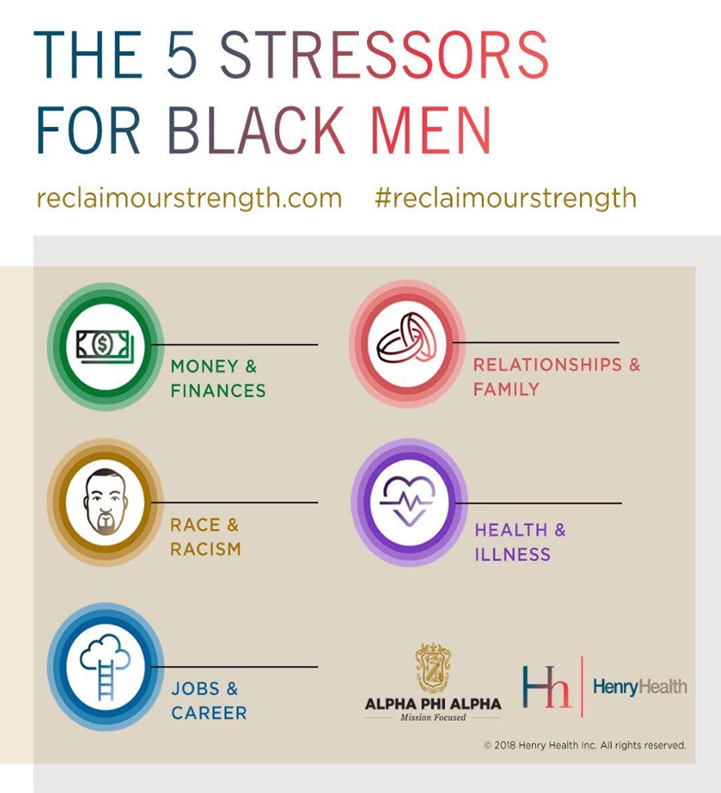
Across the United States, many Black men describe a quiet but persistent mental heaviness. It doesn’t always present as panic or despair. More often, it appears as hesitation, second-guessing, and a low-grade uncertainty that hums beneath daily life. Researchers studying chronic stress and racialized pressure have noted that this internal strain often accumulates subtly, shaping cognition and self-perception over time rather than erupting in an obvious crisis.
Some scholars describe this condition as inherited rather than chosen.
That distinction matters.
Generations of Black men have come of age within social environments shaped by imposed identities, distorted narratives, and expectations formed under pressure rather than freedom. Scholars across sociology, psychology, and Black studies have long documented how miseducation, surveillance, and systemic misrecognition influence how people learn to see themselves. These influences are rarely transmitted explicitly. They are passed down through tone, posture, institutional encounters, and the quiet lessons of adaptation.
Long before a child can name these forces, they begin shaping internal orientation.
W.E.B. Du Bois provided one of the earliest frameworks for understanding this process. In his seminal work, The Souls of Black Folk, Du Bois described the veil, a structural condition that distorted how Black Americans were seen by the wider society and how they were compelled to view themselves through that external gaze. The veil was not psychological alone. It was social, political, and economic. It filtered perception and constrained recognition.
What many observers note today is not the disappearance of the veil, but its internal residue.
Where earlier generations faced external barriers to recognition, contemporary conditions have increasingly shifted inward. After decades of exposure to racial scrutiny, economic instability, and cultural distortion, the struggle is often no longer only about how Black men are seen, but how clearly they are able to see themselves.
Psychologists studying racial stress describe this as internalized vigilance, a constant mental monitoring that taxes attention, confidence, and decision-making. Thus, the demoralizing formation of cognitive burden is taking a debilitating physical, mental, and emotional toll on Black men today.
Data supports this shift. According to the American Psychological Association, Black men report higher levels of chronic stress exposure than their white counterparts, with disparities that persist across income and education levels. The Centers for Disease Control and Prevention has also documented elevated rates of hypertension, sleep disruption, and stress-related illness among Black men, conditions commonly linked to prolonged exposure to stress.
The result is not a lack of intelligence or discipline. It is a cognitive burden.
Yet this condition is not static.
Across Black communities, there are growing signs of intentional recalibration. Some Black men are stepping back from constant stimulation and reaction-driven environments to examine which beliefs feel inherited rather than chosen. Others are turning to study, reflection, spiritual practice, or disciplined solitude as a way to reestablish internal clarity. Men are:
- Intentionally limiting social media and news consumption, stepping away from constant commentary and outrage cycles, and choosing quieter routines.
- Returning to reading and study, whether history, philosophy, or spiritual texts. Others are carving out time for prayer, meditation, journaling, or long walks without headphones.
- Choosing smaller, private conversations instead of public debate, spaces where they can think out loud without performing or posturing.
Deliberately, men are logging off, not posting every thought, reducing the noise, and creating space to examine what they believe and why. That might look like early mornings without a phone, disciplined solitude, study groups, or a spiritual practice that happens quietly, without an audience.
Importantly, these efforts are often taking place outside performative spaces, such as social media, public forums, or highly politicized conversations, in settings where honesty is not penalized, and vulnerability is not mistaken for weakness.
This movement is not retreat; it is alignment with values, priorities, and a sense of self that feels chosen rather than inherited.
Clarity tends to emerge not through confrontation, but through discernment. Researchers studying self-regulation note that mental steadiness often begins with small acts of boundary setting, deliberate choices that reduce cognitive overload and emotional reactivity. This can look like choosing when not to respond to messages or provocation, naming pressure instead of internalizing it, or recognizing that not every request, conflict, or crisis deserves immediate attention.
Over time, these decisions rebuild cognitive authority, the capacity to govern one’s own attention, judgment, and inner direction of reality rather than having it shaped by constant pressure and external demand. Where cognitive burden fragments attention and keeps the mind in a reactive state, cognitive authority restores the ability to decide what matters, when to engage, and when to step back.
For many Black men, whose mental bandwidth is often consumed by surveillance, expectation, and social threat, reclaiming cognitive authority is not abstract. It is the difference between living reactively and living deliberately.
A man who sees himself clearly becomes less susceptible to manipulation. He no longer moves primarily from fear or approval. That grounding reshapes how he shows up as a son, father, partner, educator, or mentor. It slows reaction, sharpens judgment, and restores trust in personal perception.
When this shift occurs at scale, families feel it. Communities feel it. Conversations change. Emotional temperature lowers. Conflict becomes less combustible, not because structural problems vanish, but because individuals are no longer approaching them from confusion.

Sociologists note that collective clarity often precedes collective action. Before institutions change, people must first regain confidence in their own interpretation of reality. In this sense, clarity is not optimism or illusion. It is orientation. It is the ability to see oneself without distortion and to trust that vision.
The fog many Black men carry was inherited through history and circumstance. It was passed down through distortion, pressure, and repeated interruption of the self. But the work of clearing it has always been personal, deliberate, and ongoing.
Over time, these practices restore cognitive authority. They return a man’s ability to govern his own attention, intention, judgment, and inner direction. What emerges is not something new, but something long obscured — clarity, strength, and inner authority. Not lost, only buried beneath sustained cognitive burden and constant external demand.
When a man learns to see himself without distortion, something fundamental shifts. He becomes difficult to mislead because he recognizes false urgency. Difficult to erase because he knows his place in the world. Difficult to render invisible because he is no longer looking away from himself.
This is not withdrawal from life. It is the recovery of authorship. And once a man takes that back, both the world and his own reflection must reckon with him.
