
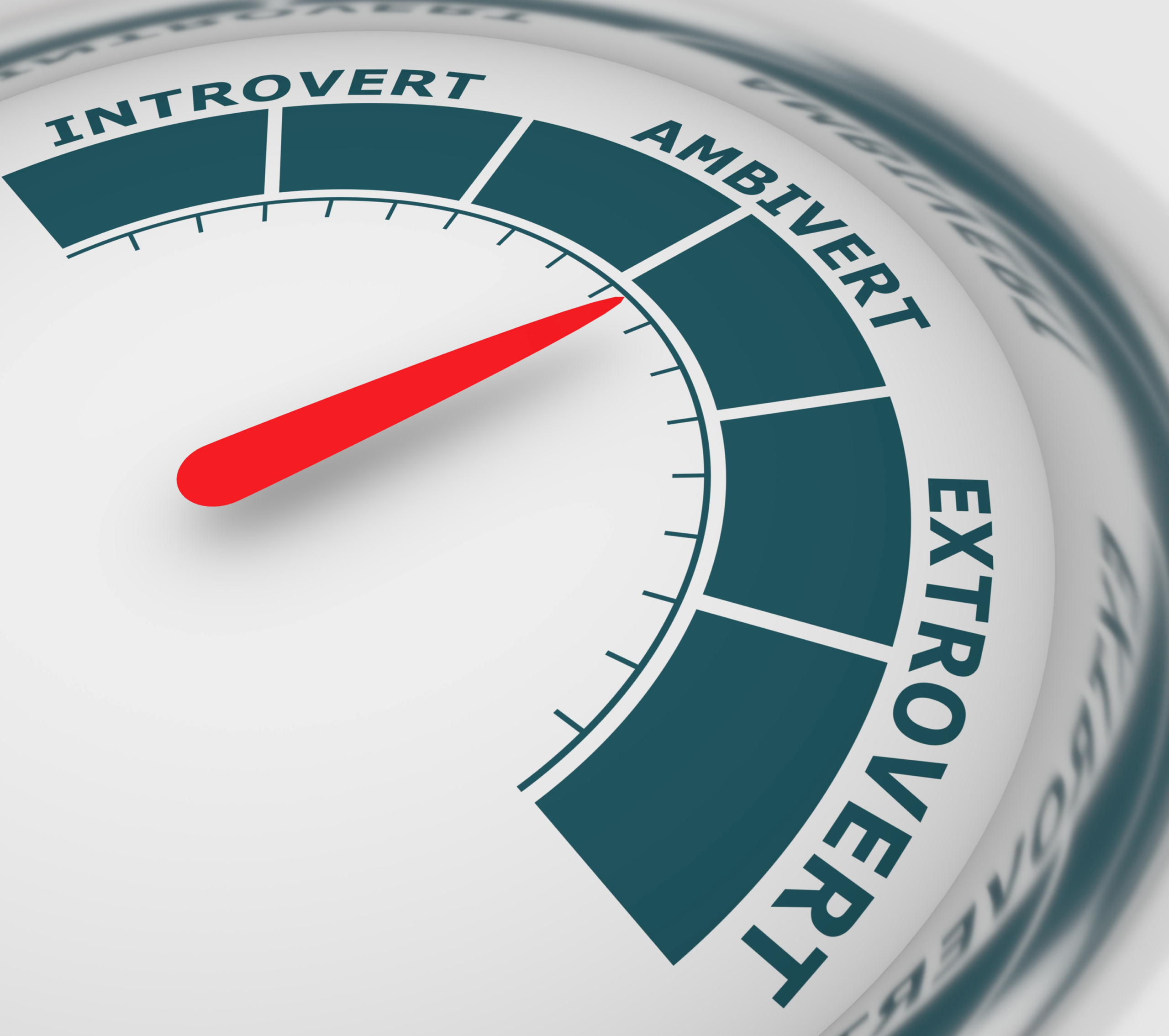
The world has changed dramatically over the hundreds of thousands of years humans have inhabited planet Earth. Yet, for all our advancements in every field imaginable, humans still exhibit four distinct personality traits. We’re all familiar with two of the types, introverts and extroverts, which were introduced by Swiss psychiatrist Carl Jung in 1921. What we’re less familiar with are the omniverts and ambiverts.
- Extroverts — which means “turned outward” — are highly outgoing, engaging, and socially confident people. It’s estimated that they are from 11–29 percent of the population. They like attention, action, and being in the thick of social interactions and activities.
- Introverts — meaning “turned inward” — are just the opposite, tending to be quiet, retiring, contemplative, and prefer not to be so socially engaged. They’d rather be left alone and like spending large amounts of time by themselves. It’s estimated they make up from 15–43 percent of the population.
- Omniverts — meaning “all” — are both extrovert and introvert, just not at the same time. A person is distinctly one or the other and can turn on a dime to be the other type depending on the situation. They also tend to be an extreme of both types. This group is much harder to discern, so no statistics are available as to how much of the population could be omniverts.
- Ambiverts — meaning “both” — are a balanced blend of extrovert and introvert and effortlessly maneuver between the two in social situations of all kinds. They enjoy times of either quiet contemplation or heightened social activity. It’s estimated that they make up 38 percent of the population, making them the largest group.
But Barry Smith, emeritus professor at the University of Maryland and the Head of the Human Psychophysiology Laboratories, suggests that ambiverts actually make up about 68 percent of the US population. That’s a huge percentage, so let’s take a look at what exactly that means.
Psychologist Dr. Darrielle Allen states, “An ambivert is someone who balances traits of both introversion and extroversion. They’re flexible, adapting their behavior to the demands of the situation. They might thrive in a lively social setting but also enjoy quiet moments alone to recharge. Ambiverts are comfortable in both environments.”
So, ambiverts are fluid in that they can, like a chameleon, move with ease between being an extrovert and an introvert in just about any situation and environment. But this isn’t a case of black and white. Ambiverts aren’t 50/50 of either of the personality types. They modulate themselves according to their mood, activity, energy level, circumstances, and what’s going on around them.
Because of their fluidity, ambiverts can be further described as subtypes: outgoing and reserved. Again, ambiverts regulate themselves according to their needs and the needs of the moment. They’ll thrive in social situations and, to recharge their batteries, will spend a little quiet time away from others. Conversely, they may prefer to spend more time in solitude and reflection, yet still enjoy social interactions.
Neutral is often a term used to describe ambiverts, as they tend to listen first, then respond. Often, their response may sound non-committal as all options sound good to them. That can cause some people to perceive an ambivert as indecisive, ineffectual, and even weak.
Sometimes, if an ambivert feels action has stalled and a conversation isn’t getting started, the extrovert in them will step in to get things activated. Dr. Allen says, “Ambiverts know when to talk and when to listen. They can be equally at ease listening quietly and contributing actively to conversations. That can make them skilled conversationalists.”

Without the dramatic personality shift that omniverts are known for, ambiverts have a more seamless changeover between types. For those trying to determine if they or someone else is an omnivert or an ambivert, this can be confusing. Omniverts aren’t subtle when being either an extrovert or an introvert. They tend toward exaggerated behavior, swinging toward the extremes of either type — and they can do this at the drop of a hat. In that, omniverts are often reactive to situations rather than responsive.
On the other hand, ambiverts are more considerate and thoughtful. They prefer balanced conversations and like coming to resolutions collaboratively. Omniverts will either dominate the conversation or be completely withdrawn, depending on their energy and mood.
Another important trait of ambiverts is their adaptability. They can comfortably work either alone or in a group with equal engagement, focus, and energy. The other term that fits ambiverts is “balance.” Ambiverts tend to be more even-keeled, but can turn it on when needed (the extrovert), as well as retreat for a while to renew themselves (the introvert). Whatever the situation, ambiverts are comfortable with the situation at hand.
Interestingly, ambiverts haven’t become a part of our everyday lexicon. The term was first introduced in 1923 by psychologist Edmund Smith Conklin, but then it quietly disappeared, possibly because the term describes a “normal” personality type as opposed to what has been considered the more extreme extrovert and introvert types. Then, decades later, British psychologist Hans Jürgen Eysenck popularized the term, which is now used extensively for business and marketing purposes.
Though a large contingent of the American population fits into the ambivert category, as with all things, there are gray areas and areas of overlap. No one is 100 percent one type or another. What’s important to understand is that personality is not set in stone and that no matter which personality type a person might be, there is always the possibility of changing to another type or becoming more fluid between the types.
One could compare it to whether people are left-brain (analytical, logical, orderly) or right-brain (creative, emotive, intuitive). No one is strictly one or the other, though they may primarily be left or right-brained and prefer one to the other. The Encyclopedia Britannica states:

“The idea that there are right-brained and left-brained people is a myth. Although we all obviously have different personalities and talents, there’s no reason to believe these differences can be explained by the dominance of one half of the brain over the other half. Recent research using brain imaging technology hasn’t found any evidence of right or left dominance.
Math, for example, requires logical thought and, thus, is generally said to reside in the left brain, far away from all those artsy right-brain abilities. But mathematics is a profoundly creative endeavor in addition to being a logical one. So, would a gifted mathematician be a right-brained person or a left-brained person? Likewise, artistic creativity isn’t just unbridled emotion. Many of the greatest works of art are products of rigorous, precise thought.”
So, being an ambivert is a great position to be in. Imagine a world of only extroverts and introverts. There would be a lot of tension, friction, and divisiveness as the two confronted each other. Ambiverts bring much-needed balance and neutrality to the sphere of human endeavors, and their fluidity and adaptability are extremely valuable in addressing life’s challenges.
Wherever you fall on the spectrum of personality types, honor who you are and capitalize on the positive aspects of your type. Then allow yourself to explore and become even more expansive. Let the world be your oyster and you the pearl!
