
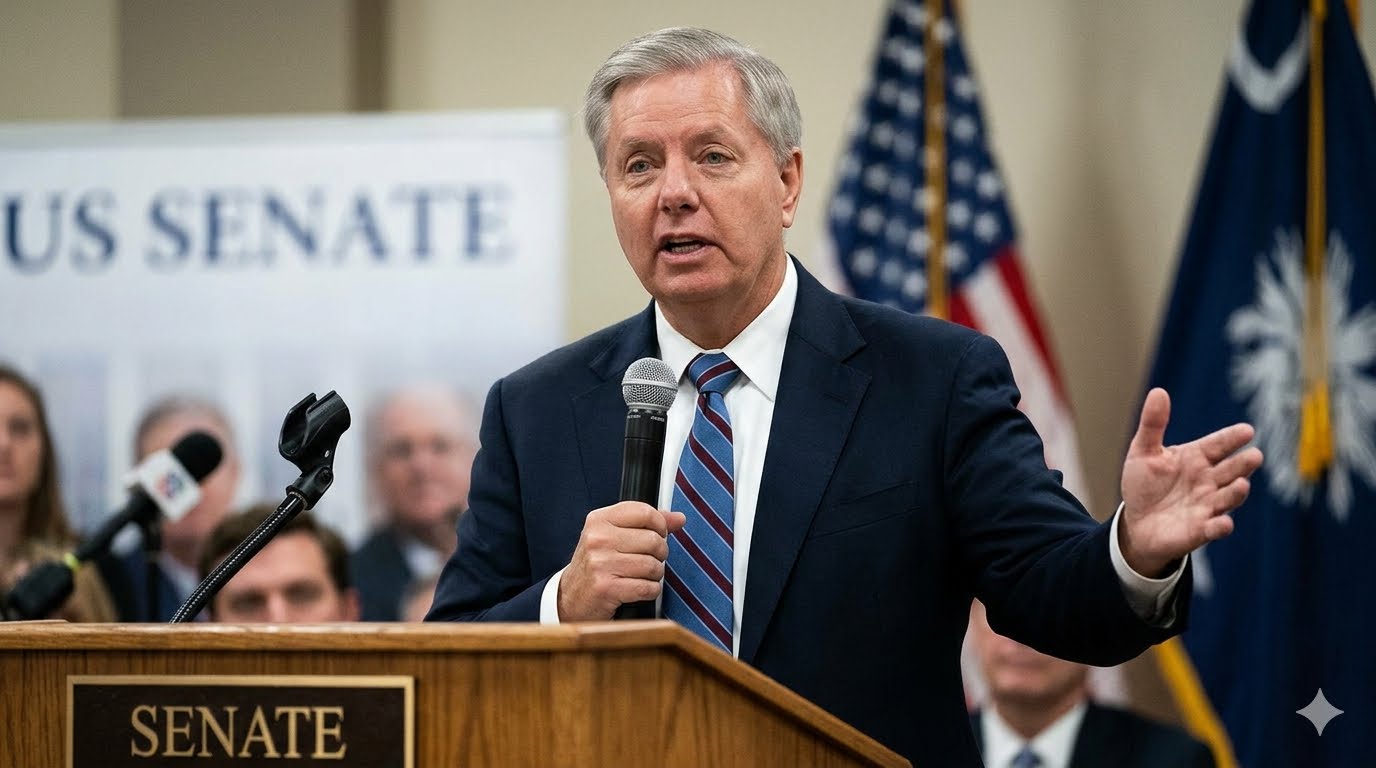
Senator Lindsey Graham died on a Saturday night in July.
By Tuesday, his sister, Darline, had taken the oath and sat down in his seat. She had never held elected office. The governor called it a continuation of her brother’s work.
By Friday, the president had her in the Oval Office, asking her, in public, to run for the whole term. The man had not been buried yet.
Six days. Sit with that. Not because it is scandalous, but because it is ordinary. That is how power behaves when it has no intention of letting go. It does not grieve — it reassigns.
Grief is not a verdict
When a powerful man dies, the machinery starts up, and it’s built to do one thing: move him beyond the reach of judgment. Friends remember the call he returned, the favor he did, the uniform he wore.
Most people have nothing against a man being mourned. Mourn him. But a eulogy is not an evaluation, sympathy is not a standard, and the fact that a man was decent to the people he could see settles nothing about what he did to the people he never had to look at.
Political leaders must be judged by what they did with power, who benefited, who paid the price, and what their decisions produced.
What the record says
Power is not private. A vote becomes a law that outlives the man who cast it. A confirmation can shape the law for decades. Silence becomes permission, and permission becomes the water the rest of us swim in.
Graham once looked at Donald Trump and named him plainly: a race-baiting, xenophobic, religious bigot, and warned that his own party would deserve whatever came next if it nominated him. Then he spent the rest of his life as one of that man’s most dependable defenders.
As chair of the Senate Judiciary Committee, he helped turn the federal courts into the most durable thing that administration built. Twenty-two circuit judges. Ninety district judges. The defense of Brett Kavanaugh. They will still be ruling when the children in our houses are grown, on whether they can vote without a fight.
In 2021, he voted against advancing the John Lewis Voting Rights Advancement Act. Lewis had his skull fractured on a bridge in Selma for the right that bill was written to defend.
These are not merely flip-flops. They are exercises of power with dates attached, and their consequences are the house we live in.
Turn the standard around
A standard applied only to strangers is not a standard. It’s a weapon.
If it’s right, it’s right everywhere. It applies to people who share our party. It applies to people who share our face.
Stop confusing representation with direction. A Black face in a high place can matter. Visibility is not courage.
So ask our own the same questions. What did you do with power? Who benefited? Who paid the price? Did you defend the vote, or get quiet when defending it carried a bill?
Ask it in cities where Black officials hold the mayor’s office, council seats, school board positions, and police leadership, yet too many children remain trapped in failing systems. Representation does not excuse those outcomes. It makes the demand for an accounting more urgent.
The standard we inherited
We remember Martin Luther King, Jr. for the preacher’s cadence in his voice, the way he could lift a room, steady a people, and make hope feel possible. But the power was not only in how he spoke. It came from the moral clarity beneath his words, a clarity he refused to surrender.
Nobody elected him to public office. His power came from the fact that his words, his actions, and what he was willing to sacrifice all lined up. He said what he believed, lived what he taught, and was willing to pay the price for it.
Frederick Douglass, W.E.B. Du Bois, Ida B. Wells, Ella Baker, and Malcolm X did not agree with one another. But not one of them mistook being recognized for leading.
Individual achievement is not collective freedom. We have doctors, lawyers, professors. We run cities, school districts, police departments. And the masses of our people are still suffering. We keep pointing at the ones who made it and calling it progress.
Whether we like it or not, the sanity of our community is heavily dependent upon the sanity of Black men. What is meant by sanity is the capacity to see clearly, keep our word, and protect what comes after us. Not our moods — our minds.
Black women have carried more than their share of everything, and they are carrying it this morning. Naming our duty does not diminish them. It ends our excuses.
Before a man can lead in public, he has to lead himself.
Leadership begins in the mind. It begins with what a man believes, what he fears, what he will stand for, and what he is willing to give up just to be accepted.
Power always goes after the mind first. It uses fear. It uses comfort. It uses ambition. It offers access and whispers that staying close to power matters more than telling the truth.
Sometimes power doesn’t have to take a man’s mind. He hands it over.
A man ruled by fear, ego, or the hunger to be accepted cannot lead anybody toward freedom. Put that man near power, and what is broken inside him will not stay private. It enters his decisions. It enters the institutions he controls. It enters the lives of people he may never meet.
Other people’s children pay for it.
That is Graham’s arc. He saw the danger. He named it. Then he stood beside it and helped it grow. Nobody took his clarity from him. He put it down.
Clarity over confusion — truth over comfort — purpose over performance.
But clarity that never becomes courage is not leadership. A man can be calm, disciplined, and centered and still be useless to his people.
Between now and November
Vote. Then refuse to act as though voting is the only thing on the list of things to do to improve our conditions.
Study the record, not the noise. Know what your representatives have done, not what their mailers say. Question the loyalties you inherited and never examined. Teach your children the history being pulled off the shelves right now, while we scroll.
None of this takes a new organization or another conference. It takes the places we already sit together: the barbershop, the church basement, the porch, the dinner table.
Leadership here is not a title. It’s a practice — showing up prepared, informed, disciplined, and accountable. It shows up in how we vote, how we raise our children, and how we hold our institutions responsible.
The last word
Lindsey’s seat was filled in three days. Those judges may remain for decades. The tributes fade. The record doesn’t move.
So do not ask whether a man speaks our language, wears our label, or calls us brother.
Ask what he did with power. Ask who benefited. Ask who paid. Ask what it produced.
Power leaves a record. Our job is to read it clearly, judge it honestly, and refuse to hand our future to anyone who wants the authority of leadership without accepting the weight of it.
This moment is not about waiting for another movement. It’s about becoming the people prepared to build one.
Lindsey Graham left a record. So will we.
